Long-term serological monitoring of Leishmania infantum in European wild rabbits (Oryctolagus cuniculus) in Mediterranean ecosystems of southern Spain
Abstract
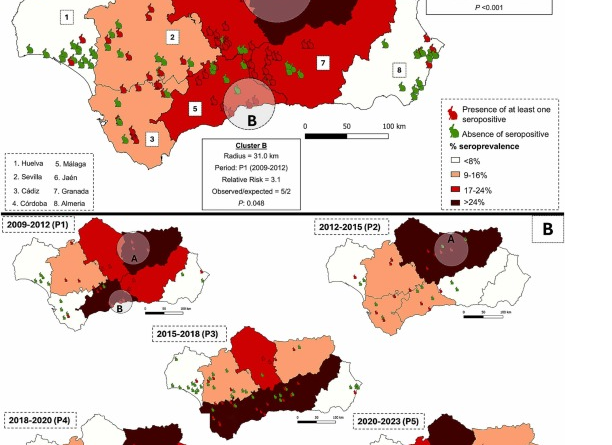
Leishmaniosis is a vector-borne zoonosis mainly caused by Leishmania infantum in Europe. Exposure to this protozoan has been widely documented in various domestic and wild species, which have been suggested as competent reservoirs of L. infantum in anthropogenic environments. Notably, wild lagomorphs, particularly the European wild rabbit (Oryctolagus cuniculus), have emerged as key natural reservoirs, linked to human leishmaniosis outbreaks in Spain. Despite their recognized role in the L. infantum epidemiology, significant knowledge gaps remain regarding the spatiotemporal dynamics of this pathogen. Consequently, this study aimed to evaluate the long-term circulation of L. infantum in wild rabbit populations in Mediterranean ecosystems of southern Spain. Thus, 1076 wild rabbits were analysed across five consecutive study periods: 2009–2012 (P1), 2012–2015 (P2), 2015–2018 (P3), 2018–2020 (P4), and 2020–2023 (P5), using the indirect immunofluorescence antibody test. Overall seroprevalence was 14.8% (159/1076; 95% CI: 12.7–16.9). Seropositivity proportions fluctuated but remained homogeneous over time (P = 0.10), ranging from 10.7% (P4) to 18.5% (P1). Spatiotemporal analysis identified two statistically significant clusters of L. infantum seropositivity within the study area. Although rabbit density was significantly associated with L. infantum seroprevalence, its overall contribution appears limited. This long-term surveillance reveals endemic, widespread, and spatially heterogeneous circulation of L. infantum in wild rabbit populations within the study region, underscoring their role as maintenance reservoirs in Iberian Mediterranean ecosystems. These findings provide key spatiotemporal insights into L. infantum dynamics, essential for designing and implementing effective surveillance and control strategies in high-risk areas.